
Tags
I recently came across something I wrote a while ago about omelets, which are pretty simple things really. Simple until you start mucking about with them, that is. Then they become complicated.Like the rib of beef I cooked a few weeks ago; brown it on both sides, pop it in the oven for a few minutes, rest, carve, eat. Job done.The devil, for omelets and rib of beef, is in the details, the provenance of your eggs and beef, the care the producer has taken over what her animals have eaten and, in the case of the beef, the care taken over the slaughter and ageing of the beef (which, incidentally, is not something generally done very well in France).Buy cheap eggs or cheap beef and, no matter how well your preparation and cooking go, you’ll end up with a meh result. Equally, buy the best products – and prepare them using your incredibly expensive knives and equipment in your multi-thousand dollar kitchen – using rubbish techniques, and you’ll still end up with a meh result; perhaps even more meh than the cooking goddess who starts with average products and applies great care and techniques.So to roast chicken. The bird above started out as a cheap supermarket Poulet Jaune, a yellow chicken so called because, duh, it’s yellow. The yellow comes from the corn it’s fed during its short one-month life.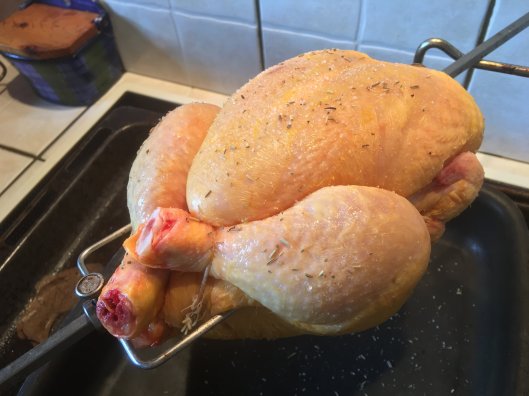 Then comes the application of a little seasoning – fine-grain salt all over and a large pinch of herbes de Provence – and the heat. In this case it’s cooked in a rotisserie oven. Which makes all the difference.Back in my professional life we’d roast a chicken for one hour; the first quarter hour on one thigh, then the second on the other thigh, the third on its chest and the final quarter of an hour on its back to crisp the breast. It’s a finnicky process because you have to set timers or have a good sense of time to keep on schedule, but it’s important to prevent whichever side is uppermost from drying out. You also have to baste your beast (as with any roast meat) using the juices in the pan.A rotisserie oven does all this for you, auto-basting the bird and ensuring that each side gets an even amount of heat, producing a far superior bird than even the most assiduously turned one.I’d like to say I carefully planned for and chose our rotisserie oven, but it was here when we moved in; and the first oven I bought in France had one too, so perhaps it’s just a Thing here. But well worth it for the difference it makes to roast chickens – I don’t use it for anything else, although perhaps I should.
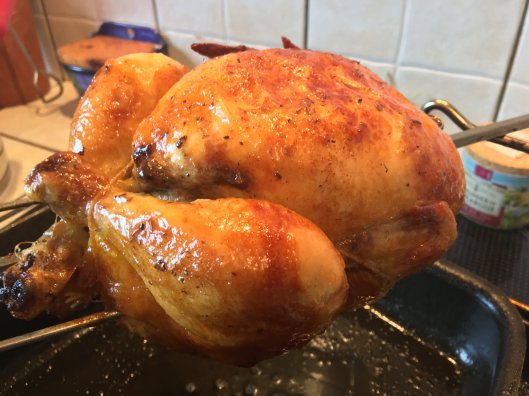 An hour or so later it’s ready, cooked to perfection. There’s a cooking pan underneath the chicken to catch the juices which I use to make a sauce. While the chicken is resting for 10-15 minutes, I put the pan on a high heat and deglaze with some alcohol – this time I used some muscat wine. Scrape up all the stuck on bits and reduce the liquid to almost nothing, then add in some chicken stock. Reduce this down until it’s the thickness you like and serve. It takes 5-10 minutes, and you can leave it alone to make a lovely sauce while you prepare your veg.And really that’s all there is to it, apart from carving the chicken which can be an art in itself. To do this properly you need to learn from a Maitre d’hotel who has learned at the side of another master, they will do it perfectly.Essentially, you remove the wings, then the legs which you divide into upper thighs and drumsticks. Then you remove the two breasts, cutting them each into two portions. In all you can make 8-10 (small) portions from a 1.5 kilo bird.Very simple. N’est-ce pas?
 mostxlnt.com