
• Home
  • Ordinary Immortals Novel
  • The Cookery Book
  • The Recipes
  • List of posts
  • Seconds

Most Excellent!

Most Excellent!

Category Archives: Recipe

Miam, as they say in French

05 Sunday Jun 2016

Posted by chriswardpress in Recipe, Uncategorized, Vignette: A slice of m...

≈ 3 Comments

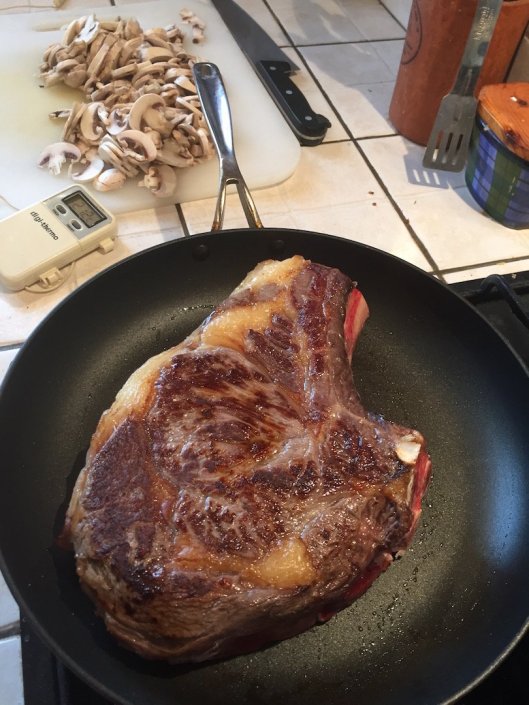
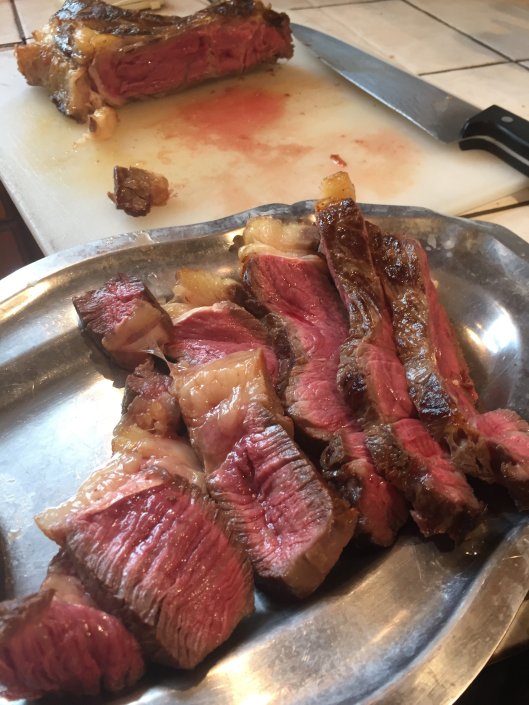
The cooking is really simple; all the complicated bit is done by the farmer who raises your rib, the butcher who chooses, ages and cuts it and then you who buy the right one. IMG_2017Once you’ve done the hard bit, fry off your rib of beef just to colour it – the outside looks lovely, the inside remains essentially raw. This will take about four or five minutes. Top tip: wipe the surface of the meat to get it as dry as possible; if you leave it moist this will produce steam and stop it attaining maximum heat to produce the essential Maillard Reactions. Second tip: salt the surface of the meat with fine (table) salt just before putting it in the pan; if you salt it before it’ll draw moisture out of the meat, and if you don’t salt it it won’t taste as good.Don’t be afraid to turn up the heat to maximum, since you’ll be paying close attention to it and not letting it burn.IMG_2020Once the rib is browned, put it into the oven at 180°C for, well, as short a time as you dare really; the one you see here had 7 minutes to come out ‘saignant’, rare. 12 minutes will give you medium. 3 hours and it’s ready for my dad.It’s very important to rest your meat for as long as you’ve cooked it – so another 7 minutes in this case. It won’t go cold, although you can cover it with some tin foil if it makes you feel happier. Resting allows the juices to return inside the cells – it’s not scooping up the juice that flows out (that you should add to your sauce), it’s making the meat itself juicier inside.Then slice and serve it.Traditionally this would be served with oven roasted potatoes (roasted in duck fat, obv.), seasonal vegetables (or just a little salad) and mushroom sauce (recipe later).
Recipe: Pommes Dauphine

20 Wednesday Aug 2014

Posted by chriswardpress in Recipe

≈ 1 Comment

Tags

boiling oil, Choux pastry, Pommes Dauphine, Potatoes, Simples

Ingredients250g mashed potato (see purée de pomme de terre recipe after chapter 22)250g choux pastry (see Choux Chantilly recipe after chapter 29)1 vat of boiling oil (optional)MethodFirst, don’t make your mashed potato too wet – hold back on the milk, add perhaps half the regular amount of butter and keep it stiff. Chaps.Next, don’t add the sugar to the choux recipe. Sugar and potatoes don’t go together so well.This recipe is simplicity itself. Mix the potato and pastry together in equal quantities and then cook dollops of it in oil at 180C. Alternatively if you’re on a health kick (sorry but you may be on the wrong track reading this if that’s the case) you can pipe the mixture onto baking sheets, brush them lightly with butter or even olive oil and bake them in the oven for about 15 minutes at 180C.And that’s all there is to it. Simples.

Recipe: Choux chantilly

20 Wednesday Aug 2014

Posted by chriswardpress in Recipe

≈ Leave a comment

Tags

Chantilly cream, Choux buns, Choux chantilly, Courage!

Ingredients250ml water5g salt10g sugar (or none if you’re making savoury buns)80g butter cut into small pieces125g plain flour4-5 eggs depending on size – see methodFor the Chantilly cream you’ll need:60cl thick cream40g icing sugarA couple of drops of vanilla extractMethodChoux pastry has a reputation for being very hard to make. It isn’t in fact the case, provided you follow the instructions, weigh everything twice and don’t panic. And, most importantly, cook your choux buns for longer than you think necessary. Be brave! If I’d been braver I’d have had a extra point on my final cookery exam when I qualified.OK, boil up the water, salt, sugar and butter in a saucepan to emulsify them. Away from the heat add all the flour in one go and mix vigourously with a wooden spatula. When it’s well mixed, return it to a gentle heat and keep stirring to dry your mixture. This is quite important – the choux buns will rise because of steam from the water trapped inside, but if there’s too much water they’ll be soggy. So, clench your flat-ended wooden spatula in your fist and ‘chunk’ the mixture off bit by bit, dragging it across the bottom of the saucepan until it steams no more.Remove from the heat when you get bored doing this and add the eggs one by one. After adding four check the consistency – it should be ‘dropping consistency’, i.e. it should drop from your spatula not too quickly, but quite easily. If it’s too stiff, add half your fifth egg, test again, and add the rest if necessary.OK, hard part over, hardest part coming up. Using a piping bag or a plastic bag with a corner cut off, pipe the mix onto a baking tray in regular quantities. Leave room between them for them to expand. The hole in your bag should be 1-1.2 cms in size and they should be about 3cms high.When you’ve piped them all out, use a damp fork to flatten the tops evenly and then put them into a 200C oven for 25-30 minutes. The temptation will be to take them out after 20 because they’ll look cooked, but the insides will still be moist – and that’ll lose you a point or two in your exam. So be careful.Also, professional ovens have ‘ouras’, vents that can be opened to allow steam to escape from the oven. You can achieve a similar effect by cranking up the temperature to 220C and slightly propping open the oven door with a teatowel or spoon or whatever for the last five minutes of cooking. Be brave.When they’re done – they should sound hollow when tapped underneath and the insides shoudl be dry – put them to cool while you make your chantilly cream.A good tip for whipping cream is to keep everything as cold as possible – put your mixing bowl and cream into the fridge or even freezer before starting, although you want the cream to still be liquid so don’t leave it too long.Add the sugar to the cream and whisk it – on crushed ice if you like, every little helps – until it sticks together nicely.Then you can either pipe the cream into the base of your choux buns or open them up and spoon it in. You may have to lick your fingers a lot using this method.Sieve some extra icing sugar over the top and there you go – an exam-winning dish.

Recipe: Chicken Chasseur

20 Wednesday Aug 2014

Posted by chriswardpress in Recipe

≈ Leave a comment

Tags

Brandy, Brown stock, Chicken chasseur, Monter au beurre, Mushrooms, Traditional recipe

Ingredients1 chicken, about 1.2 kilos100g flour80g butterHalf a litre of brown chicken stock (see recipe after chapter 17)For the sauce you will need:2 shallots, finely chopped250g button mushrooms, half of them chopped the rest – smaller ones – whole5ml brandy10ml white wineA little of your chicken stock20g butterA little tarragon – a couple of stalksA little chervilSalt and pepperMethodThis is a very traditional French recipe. I just managed to outrage my French wife by remarking that I haven’t cooked this recipe in ages, so guess what we’re eating tonight? Well, this weekend anyway.First, you need to cut up your chicken. In a professional kitchen, we’d cut up say half a dozen chickens and use the resulting carcasses to make the stock in this recipe, and if you have the time I recommend doing the same yourself. Start with the chicken side-on to you, breast uppermost. Using a sharp knife (I know, I shouldn’t have to specify but….) cut around the skin between the thigh and the body – you’ll find that there’s a gap there under the skin. Pull the thigh away gently and you’ll find the joint – cut through the tendons holding it together. Then cut the drumstick away from the upper thigh – two portions.Do the same with the wings, taking a little of the breast with them. Two more portions.Now with the breast uppermost, cut down from the pointy end towards the bum, until you get to the wishbone. A professional chef, or a culinary student, would already have removed this. Lazy chefs and students leave it in and just cut along it. Then insert your knife between the flesh of the breast and the ribs, with the blade parallel to and even lying along the ribs and cut down to separate the meat from the carcass. Cut each breast in half to give two portions. Go slowly and you’ll manage it, the first two or three hundred are the hardest.Or just by chicken joints. Your choice. Note, the official cook book allows 30 minutes for this procedure, but it is for two chickens not one and 15 minutes seems generous to me.Anyway. Salt and pepper the chicken pieces and fry them in hot butter and/or oil, until they’re nicely tanned – about 10 minutes. Then pop them onto a metal dish and cover with foil to finish cooking them in the oven at 180C for another 10-12 minutes. You may want to take the breast portions out a few minutes before the thighs, which need more cooking.In the pan in which you cooked the chicken, carefully pour off any excess fat and fry the chopped mushrooms for a couple of minutes, then add the shallots. Fry the mushrooms on the highest heat possible – the aim is to get rid of the water in them.Once the shallots are tender, add the cognac and flambé the mix. If you’re a steely-eyed professional chef you do this by tipping the pan casually to one side so the brandy slops onto the gas flame and sets fire to the whole pan. If you’re a wimpy civilian you point your blowtorch at it at arms length and shriek mightily when it catches light.Deglaze with the white wine – that means slosh it in and stir it round with a wooden spatula to pck up all the nice crusty maillard reaction bits from the bottom of the pan – and add in the stock and button mushrooms. Reduce it down ferociously to about half its starting volume then remove from the heat and whisk in the 20g of butter. This is called ‘monter au beurre’, to mount with butter. When your guests remark on the unctuosity of the sauce you can say, casually yet professionally, “Oh yes, it’s monté au beurre” and make as if they’d understand what you meant. Which they will if they’re French.Add in the herbs, lightly chopped, and nap it over the finished chicken portions. Note, the official recipe book require that, when you dress the plates, the points of the wings and drumsticks must point towards the centre of the plate.Etiquette. You may have heard of it?

Recipe: Omelette

20 Wednesday Aug 2014

Posted by chriswardpress in Recipe

≈ 1 Comment

Tags

Butter, Eggs, nothing else, Omelette, Omlet, Salt

Ingredients3 eggsThat’s it, nothing else. Just three eggsOh yes, salt. A pinch of salt.But that’s all.Salt and eggs.Oh, a knob of butter too.But that’s definitely it. Really nothing else.At allMethodThe simplest recipes are the hardest to master. Take the earlier (after chapter 22) example of mashed potato, which has only three or four ingredients – potato, butter, salt and perhaps milk. It takes longer to write down the recipe than it does to cook it. Good grief.Same with omelettes. An omelette can, of course, have many more ingredients and many optional flavourings, but the corridor to hell is papered with false omelette recipes.So, first, put your omelette pan on to heat, and get it good and warm but not smoking hot. Your omelette pan will look like many other omelette pans but this is your omelette pan. Your omelette pan is your best friend. It is your life. You must master it as you must master your life. Your omelette pan, without you, is useless. Without your omelette pan, you are useless.Above all, NEVER let your spouse near your omelette pan. They will claim it is dirty and wash it, scour it and put it in the dishwasher. And then you will have a freshly-dug grave in the garden to explain to the nice police officer.Cast iron, conditioned according to the best advice you can find on the internet. Or non-stick. I’m afraid I’m actually agnostic on this point, what counts is the quality of the eggs and your technique.So, roughly beat together the eggs with a pinch of salt, using a fork. When the pan is nicely hot, add your knob of butter. When the foam has settled and just before the butter colours – you don’t want beurre noisette for goodness’ sake – pour in the eggs. Swirl them gently round the pan to make sure all the bottom is coated, then start drawing the already cooked mixture from the edges into the centre using the back of your mixing fork. Check and re-check the heat, you don’t want to colour the eggs at all, just set them.Keep drawing the mixture into the centre with the fork until it’s almost set all across, then tilt the pan at 45 degrees with the handle up towards your chest and encourage the top edge to fold over with your fork. The omelette should be ‘baveuse’, slobbery like a labrador, or ‘eek that’s not cooked’ if you’re my mother or any other English person, come to think of it.Ignore the shreiks and, with the pan still at 45 degrees, gently encourage it to fold over again and out of the pan onto your warmed, waiting plate. The omelette should be nicely yellow not browned at all, almost in a roll and gently leaking a little bit of runny egg from each end.Eat it immediately with the same fork you used to mix and then move round the mixture, especially if it’s you doing the washing up.If you are a heathen you may wish to add some chopped herbs just before the folding part of the event – chives, dill and parsely individually or together are popular I hear, down in the cheap seats where they like to call such things ‘fines herbes’. If you run a restaurant you’ll probably be obliged to add in cheese, ham and goodness knows what else. Do what they want, they’re paying to feed your plain omelette habit after all. They probably won’t even care if the outside is browned.Animals.

Recipe: Beurre blanc

20 Wednesday Aug 2014

Posted by chriswardpress in Recipe

≈ Leave a comment

Tags

Beurre blanc, Butter, Shallots, White wine, White wine vinegar

Ingredients250g butter (the best you can get. Unsalted of course)150g – 200g shallots20cl white wine10cl white wine vinegar10-20cl cream (very optional)MethodCut the butter into 1cm cubes and put it back into the fridge.Now chop your shallots VERY finely. Very. 1mm dice. It’s easier, as I may have mentioned, when you’re on your 200th kilo of them.Put the shallots, wine and wine vinegar into a saucepan (sauteuse, if you want to be smart) and bring gently to a boil then allow to simmer. Reduce the liquid down to almost nothing – 5-10 minutes. Don’t do it too quickly, you want the shallots to absorb the flavour of the liquid and vice-versa. You can use the time to argue with any passing French person about the exact proportions of wine and vinegar you should be using, or even if you should be using wine or vinegar at all. This may get quite heated but you probably won’t need a knife, although you should keep one within reach.When the liquid has all almost but not quite gone, reduce the heat by half and start adding in the butter piece by piece, stirring it in with a whisk energetically. Don’t, whatever you do, show your chef the page in the official recipe book which suggests that the butter you use should be softened. Well, not unless you want to drive him into an apopleptic rage, that is.If you’re reet posh you may wish to strain the sauce, but most people prefer this sauce with the bits of onion in it so don’t bother. Unless, as I say, you’re posh.You should serve it straight away, or if you have to keep it at 45C-50C for a sort time. It can’t be made in advance and reheated, it will separate out and you’ll need to start over.Nap it over fish, as is traditional, or if you’re a daring radical think of adding some chopped herbs or vegetable purée (peppers, for example, or dill) and serve it with vegetables.This is my favourite sauce, I should note. Usually I have to make double portions because, as my wife puts it, ‘Je le mange à la louche’, I eat it by the ladleful.

Recipe: Purée de pomme de terre – mashed potato

20 Wednesday Aug 2014

Posted by chriswardpress in Recipe

≈ Leave a comment

Tags

Butter, Fight!, Mashed potato, Milk, Potato, Purée de pommes de terre

Ingredients1 kilo floury potatoes250g-500g butter (yes, half a kilo)250ml-500ml milk (basically you want your milk and butter together to weigh half what the potatoes weigh)10g saltMethodFirst, put down that potato peeler. That’s it, put it down. On the floor. Now kick it towards me. That’s right, nice and easy now.Please. Stop peeling your potatoes. It’s no good for them and definitely no good for you. OK?Right. Next, verify that your potatoes are the same size. You need to do this so that they all cook at the same speed, OK? Titchy potatoes will be cooked before the giant ones. It sounds obvious now you read it, but it isn’t unless you know it. Also, while it’s sometimes acceptable to cut up potatoes so the bits are the same size it’s not recommended from a flavour point of view – the cut surface allows water to penetrate the potato and spoil the flavour (OK, only a bit but we’re going for the best ever mashed potato here so nuances count).Now the best kind of potato for this are Pommes Rattes. Usually you find these in fairly small sizes, about the length of your thumb, but bigger ones are best and, most importantly, peel.Yes, peel. You will, eventually, peel these potatoes but not now, calm down big boy.Put the potatoes in a saucepan, cover with water, add the salt. I’m always being asked how much salt – well, 10-12 grammes per litre of water is the official amount. A good three-fingered pinch of cooking salt – not table salt – is the generic, about-how-much quantity. Do use cooking salt, by the way, the iodine in table salt doesn’t do cooking flavours any favours. Remember, we’re talking nuances here – but three nuances make a wodge and four wodges make a heap of difference.It’s going to take about 20-25 minutes to cook the potatoes, so spend the time lightly melting the butter and warming the milk in whatever proportions you like. I go for 50/50, an assertion which is enough to start a fight in the bar of most French cookery schools. Bring up ‘bouillabaisse’ if you fancy a knife fight.When they’re cooked – test with the point of a fine-bladed knife, not the prongs of a fork – strain them and peel them. Straight away. So prepare to burn your hands – or hold them in a tea towel, your choice. You’ll find that after a little practice you can peel off just the very outer layer of the skin, the coloured part, between your thumb and a knife blade. You’ll also need to cut out any major blemishes and marks.Now instead of mashing with a potato masher, either use a moulin a legumes, a vegetable mill, or a potato ricer. The moulin looks like a conical metal bowl with a mesh base and a stirring paddle in the middle – feed veg into the top and purée comes out of the bottom. Every French house has one, knock on any door and ask to see theirs – they’ll be happy to show theirs off and explain its use in great detail. Honest.The potato ricer looks like a giant garlic press – pop a potato in the top, squish down the press bit and purée comes out of the bottom.Whichever you use, let the purée fall into a dry saucepan. When you’ve puréed all the potatoes, set it on a medium heat and stir with a wooden spoon or spatula to dry the mix as much as possible. This is one of the great secrets of great mash – dry the spuds after cooking them.When they’re dry enough (this, happily, normally coincides with the moment when you get bored and/or tired of the drying process), start adding the butter a little at a time, now beating the mix with a decent-sized baloon whisk. Heretics choose to use electric mixers at this point but they will burn in hell later for their sins.Once the butter’s all been added, start adding the milk a little at a time. Be more careful now, this is where you’re going for your chosen consistency – which should be a little runnier than you think it needs to be. Keep whisking furiously all the time, and continue to beat your mixture when all the milk’s been added, always over your medium heat. It’s this portion of the event more than anything which will give unctuosity to the final result.You also need to whisk like mad to emulsify the mixture – potatoes and this much milk and cream are not an entirely stable mix. They won’t go bang – that’ll be your stomach after eating your fourth portion – but they will start to separate eventually.This method is largely based on that of the great French chef Joel Robuchon, who made purée de pomme de terre one of his signature dishes. Watch https://www.youtube.com/watch?v=qTTvZ2PW96k for all the gory details.

Recipe: Tarte au riz à la Normande

20 Wednesday Aug 2014

Posted by chriswardpress in Recipe

≈ Leave a comment

Tags

It has custard!, It's a rice pudding, It's an apple tart, Tarte au riz a la Normande

Ingredients1 pastry case1 rice pudding1 Crème anglaise1 apple tartMethodAssemble in the above order, bottom to top. Eat. Burp. Lie down swearing you’ll never, ever eat so much ever again.Ha ha ha ha!OK, joke over because this pudding is No Joke. When I wrote the chapter about cooking it, I called it “Now THAT’S a pudding!” and I wasn’t joking. It is effectively an apple tart on top of a rice pudding which you’ve enriched with Crème anglaise. No chantilly cream needed for this one.OK real ingredients now1 ready-made pastry case (see recipe after Chapter 15, taste aux pommel)500 ml Crème anglaise1.2kg apples750ml milk150g pudding (round) rice25g butter150g sugar1-2 vanilla pods10g cinnamonYou need quite a deep pastry case for this recipe, say 4-5 cms deep – so use a deep dish and don’t trim the pastry as you would for an apple tart. And first, go read the Apple Tart recipe after chapter 15 – this recipe is essentially that with a rice pudding slipped inside it. Oh, you need to read the Crème anglaise recipe after chapter 14, since you’ll need that too. OK? Finished? Right.Blind bake your pastry case and make your Crème anglaise. Now boil the milk, sugar and split vanilla pod together and put the pan next to your rice pudding making saucepan. Yes, you’re going to make this on the stovetop as if you were making a savoury risotto. Except it’s a sweet one. OK? Got over that? Right.So, same procedure as for a regular risotto. Melt the butter in the saucepan, add the rice and stir until the rice looks transparent. Then add the hot milk mix a small ladleful at a time, waiting until each ladleful has been absorbed before adding the next. You’re going to be here for 15-20 minutes so by all means listen to The Archers on the radio. And a bit of Front Row too, if you like.When the rice pudding is cooked thoroughly and nice and thick, stir in the Crème anglaise – add this a ladleful or two at a time, you don’t want it to be too runny. Pour this into your pastry case and chill it, so it sets. Spread on top the apple compote as in the apple tart recipe, and finish by spreading your sliced apples on top of that – again as in the apple tart recipe after chapter 15.Finish off with the apricot jam and chill it until you’re ready to serve. Probably wisest not to serve a huge main course and perhaps you should skip the starter this time too, OK? Just saying. It is, I promise you, delicious. But filling…

Recipe: Tuiles aux amandes

20 Wednesday Aug 2014

Posted by chriswardpress in Recipe

≈ Leave a comment

Tags

Almond tuiles, Homemade, Posh biscuits, Pretend homemade

Ingredients200g chopped or crushed almonds200g icing sugar50g plain flour2 whole eggs2 egg whites50g butterA little vanilla essence if you likeSome butter to grease your baking trayMethodAlmond Tuiles are excellent for a couple of reasons. First, they fast really excellent. Secondly, and most importantly, they give you Top Bragging Rights. “Mmm, these are lovely” your guests will exclaim upon eating them with whatever cheap dessert you’re trying to dress up a bit. “Where did you buy them?”“The Almond Tuiles?” you’ll reply with initial capital letters. “Oh those, I made them this morning.”Do your best to keep a smug grin off your face and don’t, whatever you do, explain how simple they are to make.So, first you melt the butter and allow it to cool. While it’s chilling you mix together the almonds, sugar and flour and then the eggs (whole and whites) which you should lightly beat together with a fork first. Now add in the cooled, melted butter (although not so cooled it’s hard again. Duh) and the vanilla essence if you want it.Allow the mixture to rest for half an hour in a covered bowl, then put well-spaced spoonfuls onto a greased baking tray. I use silicone liners called Silpats in some parts of the world, marvelous things to which nothing will stick. Flatten the piles down with the back of a moistened fork, making sure they’re in nice, regular, I-can-pretend-these-are-shop-bought shapes and cook at 220C for around 5 minutes. You need to keep an eye on them because they go from ‘not ready’ to ‘call the fire brigade’ in about 8 seconds – a good excuse to clean the glass in the oven door.They also continue cooking for a short while after you take them out of the oven, so you need to take them out just before they’re done. Easy.Also, when you take them out of the oven they’re quite malleable – you can bend them over a glass or rolling pin to take on pleasing shapes. If you’re quick, you can roll them into a cone and drop them into a champagne flute to make nice cones for, say, your expensive pretend-it’s-homemade sorbets.I promise not to tell.

Recipe: Blanquette de veau à l’ancienne

20 Wednesday Aug 2014

Posted by chriswardpress in Recipe

≈ Leave a comment

Tags

Blanquette de veau, Expert level, Roux, Velouté

Ingredients

1.5 kilos collar or shoulder of veal, cut into reasonable chunks

200g each of carrots, onions, leeks

100g celery

2 cloves

1 bouquet garni (leek leaf wrapped around herb stalks and a bay leaf)

2 litres veal stock (see recipe after chapter 5)

For the velouté you need:

60g butter

60g flour (preferably cornflour)

1 litre of cooking juice

20cl cream

2 egg yolks

And for your garniture à l’ancienne:

250 white button mushrooms

40g butter

Half a lemon

250g small pearl onions

A little sugar

Salt and white pepper

Method

Old-style – à l’ancienne. This means that every single French person you will ever meet knows exactly how this should be cooked and, above all, how it should taste: Delicious! Their grandmothers and mothers made it for them when they were children and so you’d better get it right, i.e. exactly how they remember it tasting back when they were kids. So, no pressure then if you’re cooking for a French person.

If you’re cooking for anyone else, it just needs to be all white. All right?

So, trim the meat and then blanch it for five minutes in boiling water, removing scum and draining carefully. While this is simmering, cut your vegetables into large pieces – half or quarter the carrots and large onions. They’re going to be cooked for a while. Stick the cloves into a piece of onion so you can find them later on.

Put these vegetables and the meat back into the (rinsed) saucepan, cover with stock (or just water if you can’t be bothered to make any) and simmer for 45-50 minutes, until tender.

While this is cooking, make your roux – put the butter and flour into a saucepan and stir with a wooden spoon until the butter melts and mixes with the flour, allow to cook out gently for a few minutes.

Next, cook the small onions and button mushrooms in a little water and olive oil (not enough to cover them) with a disc of greaseproof paper, so they don’t colour. About five minutes should do.

When the meat’s cooked, remove the cooking juices, strain them and use to make your velouté with the roux sauce – add the juices little by little to the roux so you don’t get lumps, stirring constantly. Your stick mixer is your friend if you do get lumps. Then, mix together the egg yolks and cream and add them, off the heat, to the velouté mix, stirring all the time. Pass through a sieve and pour over the meat in your serving dish. It should all look perfectly white – no colour allowed. OK?

← Older posts
Newer posts →

Recent Posts

  • France needs glasses
  • I quite like cooking
  • Moaning
  • Moving on
  • Happy Birthday

Recent Comments

Patrick Mackie's avatarPatrick Mackie on 10 000*
Unknown's avatarLa Rentrée | Most Ex… on On holiday
nicola fellows's avatarnicola fellows on Trilogies.
Unknown's avatarWhat the kitchen thi… on Why small restaurants may not…
Pete's avatarPete on Quick tip: When you need three…

Archives

Categories

  • Afterwards
  • Blogroll
  • Chapter
  • Cooking
  • Depths of ignorance—
  • Influences
  • Overtime
  • Quick tip
  • Recipe
  • Restauranting
  • Review
  • Scarlett
  • Starting out
  • Stuff
  • The Book
  • Uncategorized
  • Vignette: A slice of m…

Meta

  • Create account
  • Log in
  • Entries feed
  • Comments feed
  • WordPress.com

Blog at WordPress.com.

  • Subscribe Subscribed
    • Most Excellent!
    • Already have a WordPress.com account? Log in now.
    • Most Excellent!
    • Subscribe Subscribed
    • Sign up
    • Log in
    • Report this content
    • View site in Reader
    • Manage subscriptions
    • Collapse this bar
 

Loading Comments...